民工分离撕裂中国家庭-一个工人母亲
A Factory Mother
一个工人母亲
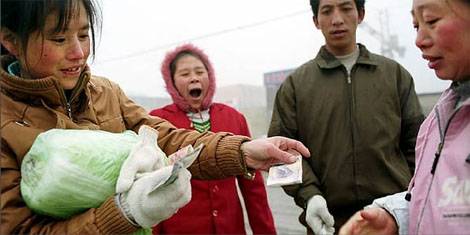
The outdoor market in Baoding is a patch of dirt where farmers have laid out mushrooms, tofu, cabbage and carrots. Cuts of meat are arranged on a flatbed, but Ran Heping cannot afford those. She and three relatives have just finished a 12-hour night shift at their factory and are making a weekly grocery run.
A handsome vendor 1 haggles 2 with Ms. Ran over the price of a head of cabbage. He is flirting 3 and offers her a ride home. She laughs and walks away. She later says distance has destroyed the marriages of several workers at the factory.
Her factory in Baoding, about 90 minutes south of Beijing by train, makes metal balls for lawn games, to be exported to Europe and America, and smaller balls that Chinese manipulate with their hands as a form of traditional therapy.
It is dirty, difficult work, but the factory is a popular destination for migrants from Shuanghu because of word-of-mouth referrals. More than half the 70 employees are from around the village. The job is piecework, so workers get paid for each ball. During peak months, a worker casting metal or polishing can make more than $100. Usually, though, workers make less than $50.
Ms. Ran came here in 2000 when she left the village to support the family. Leaving her daughter worried Ms. Ran, but Shan was starting school and tuition was due. Ms. Ran also knew that her husband's illness gave her little choice.
"I knew we couldn't survive like this," she said. "I told Shan, 'I will go to work, and you be a good girl at home' "
She returned home nearly two years later. She brought almost $1,000, which went for medical bills, clothes, food, school fees, fertilizer and other farming costs. "When the money was gone, we needed more," she said. "I decided 4 to go out again."
This time it was a shorter trip, from July 2002 until February 2003. She brought home only $210 after the factory deducted 5 $72 for leaving without working a full year. She was furious and filed a complaint with the local labor 6 bureau. Nothing happened.
The Yangs were together in the village for a year. But medical and school bills forced them apart again. When Mr. Yang left for Beijing last March, his wife left for a plastics factory. She later quit and tried to join her husband in Beijing.
"We are a family," her husband told her. "When we can, we should be together."
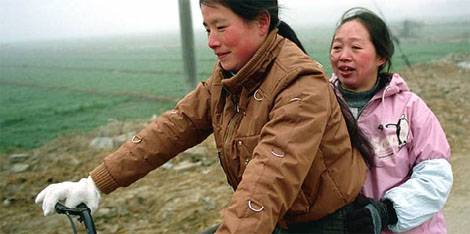
They were together for less than 10 days. Ms. Ran worked at a pastry 7 factory but quit because the pay was so bad. She also said the cost of renting a room and living together in expensive Beijing would have erased 8 the couple's savings 9.
She returned to Baoding and the metal ball factory in September. She is an inspector 10, an easier job that pays up to $40 a month. She is not lonely because several cousins work at the factory. They talk about their children or visit a local park together. There are days when she says being away in a big city can be exciting.
"There are no department stores where we are from," she said.
In November, she bought a bottle of shampoo for her long black hair. It was first time in her life she had ever bought shampoo. It cost $1.50.
These lighter 11 moments are leavened 12 by the dark. On the telephone, she pleads with her husband to see a doctor. "I said, 'When you get paid, spend all your wages to get better.' I said I would send my money home to take care of the family."
"But he doesn't really want treatment because it will cost so much," she said.
The grandparents called in December to ask for another $25 for Shan's tuition next year. Mrs. Ran wants to visit her daughter in February at New Year's. But her bosses insist she must work until July or again lose pay. She is angry but has decided she must stay. Her daughter does not know yet.
"I just hope that Heqing will recover and we can work together to put Yang Shan at least through high school," Ms. Ran said, when asked what she wanted for her future. "If his health doesn't improve, I'm worried we'll only be able to send her to middle school."
"It's a hard life," she added, "but we have no other choice."
- She looked at the vendor who cheated her the other day with distaste.她厌恶地望着那个前几天曾经欺骗过她的小贩。
- He must inform the vendor immediately.他必须立即通知卖方。
- An army of buyers haggles furiously with an army of salesmen. 一大群买主在和卖主拼命地讨价还价。 来自《简明英汉词典》
- He haggles over every ounce for everything. 他什么事都要斤斤计较。 来自互联网
- Don't take her too seriously; she's only flirting with you. 别把她太当真,她只不过是在和你调情罢了。 来自《现代汉英综合大词典》
- 'she's always flirting with that new fellow Tseng!" “她还同新来厂里那个姓曾的吊膀子! 来自子夜部分
- This gave them a decided advantage over their opponents.这使他们比对手具有明显的优势。
- There is a decided difference between British and Chinese way of greeting.英国人和中国人打招呼的方式有很明显的区别。
- The cost of your uniform will be deducted from your wages. 制服费将从你的工资中扣除。
- The cost of the breakages will be deducted from your pay. 损坏东西的费用将从你的工资中扣除。 来自《简明英汉词典》
- We are never late in satisfying him for his labor.我们从不延误付给他劳动报酬。
- He was completely spent after two weeks of hard labor.艰苦劳动两周后,他已经疲惫不堪了。
- The cook pricked a few holes in the pastry.厨师在馅饼上戳了几个洞。
- The pastry crust was always underdone.馅饼的壳皮常常烤得不透。
- He erased the wrong answer and wrote in the right one. 他擦去了错误答案,写上了正确答案。 来自《简明英汉词典》
- He removed the dogmatism from politics; he erased the party line. 他根除了政治中的教条主义,消除了政党界限。 来自《简明英汉词典》
- I can't afford the vacation,for it would eat up my savings.我度不起假,那样会把我的积蓄用光的。
- By this time he had used up all his savings.到这时,他的存款已全部用完。
- The inspector was interested in everything pertaining to the school.视察员对有关学校的一切都感兴趣。
- The inspector was shining a flashlight onto the tickets.查票员打着手电筒查看车票。
- The portrait was touched up so as to make it lighter.这张画经过润色,色调明朗了一些。
- The lighter works off the car battery.引燃器利用汽车蓄电池打火。